
TL;DR — The 2027 LinkedIn B2B Playbook in 60 Seconds
LinkedIn is the highest-authority publishing surface any professional can access for free (DR ~98–99), and it’s the only one that combines domain authority with verified professional identity — Google and AI engines both weight author credibility, and LinkedIn knows exactly who you are.
But the 2027 data changes the playbook: LinkedIn Pulse articles have lost 89% of their Google traffic since March 2024 (33M → 3.6M monthly visits), while LinkedIn posts — newly indexed by Google — grew 250% (up to 11M monthly visits). The winning strategy is no longer “write an article and wait.”
The modern system is a dual-track playbook:
-
Track 1 — Articles (
/pulse/URLs): evergreen B2B guides that rank for long-tail professional queries, earn featured snippets, and get cited by AI engines within 24–48 hours. -
Track 2 — Posts (
/posts/URLs): the fastest-growing indexed surface on LinkedIn; short, expert-native takes on category questions your buyers are Googling.
Run both, and LinkedIn becomes a compounding B2B search asset you never have to host.
Why LinkedIn Is the #1 Parasite SEO Platform for B2B
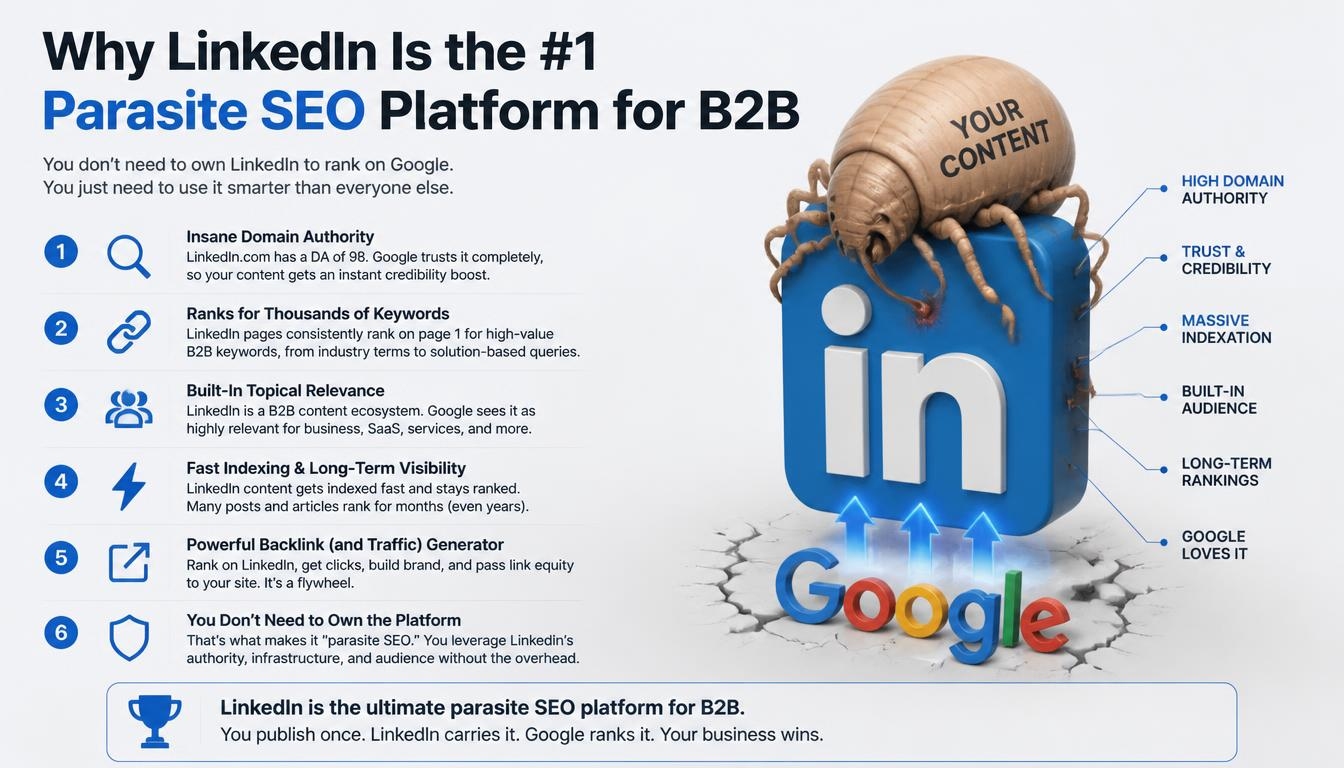
Every high-authority platform can host your content. LinkedIn is the only one where your identity is a ranking asset. Here’s what makes it structurally superior for B2B:
1. The authority advantage
LinkedIn sits consistently in the top 10–15 domains globally for authority. A well-optimized article published from an established profile competes with that authority from day one — the same article on a DR-0 company blog would need 6–12 months of link building to compete.
2. The identity advantage no other platform has
Google ties your article directly back to your LinkedIn profile: headline, work history, skills, and recommendations. AI engines (ChatGPT, Perplexity, Gemini) increasingly cite sources with author credibility attached. On Medium, you’re “a writer.” On LinkedIn, you’re a verifiable person with an employment history in the topic you’re writing about. That’s E-E-A-T baked into the platform.
3. The audience advantage — decision-makers
-
45% of LinkedIn article readers are management-level or above.
-
B2B decision-makers consume an average of 13 pieces of content before purchasing.
-
LinkedIn’s feed doesn’t just rank content — it routes it by job function and interest, meaning your piece gets surfaced to the people who can actually buy.
No other parasite SEO surface combines “Google can index this” with “the platform itself pre-screens for my buyer.”
4. The dual-engine distribution
LinkedIn gives you a distribution no other UGC platform matches:
-
Platform-internal: feed, notifications, LinkedIn search, hashtags, dwell-time-driven resurfacing days or weeks later.
-
External: Google web search + AI engine citations.
-
Network effects: shares into DMs, Slack communities, and email digests you never touch.
A post performs in all three engines simultaneously. That’s why the ROI ceiling for consistent LinkedIn operators is higher than any other platform in the pillar’s matrix.
What Actually Changed in 2026: The Articles vs. Posts Reversal
This is the most important, least-known fact in LinkedIn SEO — and most 2025-era guides haven’t caught up.
The Pulse collapse (and the posts surge)
Ahrefs data on LinkedIn’s two URL structures tells the story:
|
Metric |
Pulse articles (/pulse/) |
LinkedIn posts (/posts/) |
|---|---|---|
|
Google-visible organic peak |
33M monthly visits (March 2024) |
— |
|
Current monthly organic visits (March 2026) |
~3.6M (−89%) |
~11M (+250% since October) |
|
Pages ranking in Google |
Fell from ~5M to ~500K |
Climbing continuously |
|
Why |
Google now deprioritizes old, static, low-engagement long-form on third-party platforms |
Fresh, socially-engaged short content matches the signals Google now rewards |
What this means practically
-
Articles aren’t dead — but they’ve been demoted from the main course to a supporting role. They still rank, still earn snippets, and still get cited by AI engines (ChatGPT has cited Pulse content 105,000+ times; Pulse appears in 164,000+ Google AI Overview results).
-
Posts are now a search surface. Google began indexing public LinkedIn posts around 2023–2024, and the traffic has compounded since. If your only LinkedIn metric is impressions, you’re missing the entire organic growth channel.
-
The strategy flip: use posts as your reach and freshness engine (they perform in the feed and increasingly in Google), and articles as your evergreen citation assets (they earn the durable long-tail rankings and the AI citations).
Key takeaway: Publishing only articles in 2026 means fighting a declining traffic surface. Publishing only posts means no permanent URLs, no structure, no evergreen asset. The dual-track playbook is the whole point of this guide.
What Google Actually Indexes on LinkedIn
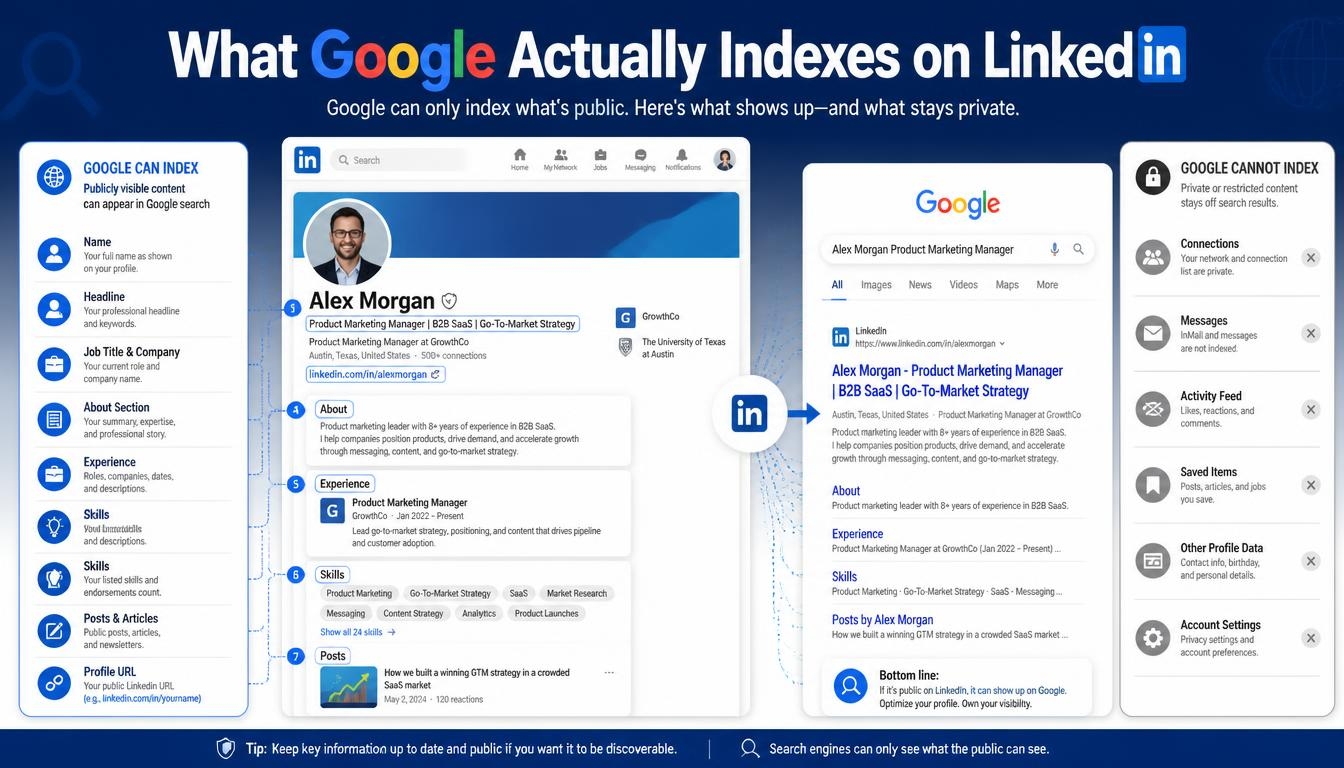
Before building the playbook, know exactly which surfaces Google can see:
|
Surface |
URL type |
Indexed by Google? |
Monthly organic clicks (2026 est.) |
|---|---|---|---|
|
Personal profiles |
|
Yes |
27.3M |
|
Company pages |
|
Yes |
23.1M |
|
Articles & Newsletters |
|
Yes (gated — see below) |
7.4M |
|
Public feed posts |
|
Yes (new) |
~11M |
|
Private/connections-only posts |
|
No |
— |
The indexation gate nobody talks about
Google does not automatically index every article. LinkedIn applies internal quality thresholds — profile age, connection count, engagement history, account trust — before allowing /pulse/ URLs to be crawled. Symptoms of an untrusted account: “Robots are blocked” errors on fresh articles.
Established profiles with strong engagement history typically see indexation within 48 hours. New or dormant accounts can wait weeks or never get indexed at all.
This is LinkedIn’s own defense against SEO spam — and it’s also why the ethically-focused strategy works: the platform itself wants real professionals publishing real expertise, and rewards exactly that.
Action item: Audit your account trust before writing word one. If your profile is new or dormant, spend 2–3 weeks rebuilding activity history (Step 3 of the playbook below) before publishing anything you care about.
Articles vs. Posts vs. Newsletters: Choose the Right Format
Full comparison
|
Feature |
Post |
Article |
Newsletter |
|---|---|---|---|
|
Character/length limit |
3,000 chars |
~110,000+ |
Same as article + email |
|
Appears in feed |
Directly (full text) |
As link card (click required) |
As link card |
|
Median reach (2026 data) |
921–1,198 (images/docs) |
596 (0.69× multiplier) |
Article reach + email |
|
Median engagement |
21–36 |
12 (0.44× multiplier) |
Article engagement + email |
|
Google indexing |
Now (new) — limited structure |
Yes — full URL + structure |
Yes |
|
Headings/H1-H3 |
Not supported |
Fully supported |
Fully supported |
|
Editable after publish |
Limited window |
Anytime |
Anytime |
|
Permanent home on profile |
Buried in Activity |
Dedicated Articles section |
Dedicated Newsletters section |
|
Custom SEO title/description fields |
No |
Yes |
Yes |
|
Email distribution to subscribers |
No |
No |
Every edition |
When to use each
Use a POST when: – The idea fits in 3,000 characters or less – It’s timely — a reaction to industry news, a hot take, a launch – You want immediate feed visibility and network engagement – You’re answering a question your buyers are actively Googling right now — you can feed-index check what best serves that
Use an ARTICLE when: – Your content requires headings, inline images, embeds, or structured logic – It’s evergreen — a guide, framework, comparison, or how-to – You want it indexed and ranking in Google for months or years – You want AI engines able to pull self-contained sections from it – You want a permanent, shareable, compounding asset
Use a NEWSLETTER when: – You’re layering email distribution on top of an article (every edition triggers a push notification and an email to subscribers — solving the article’s biggest weakness: near-zero algorithmic feed reach) – You’re building a repeatable publication with a subscriber base
The engagement paradox (why articles “look weak” but win long-term)
LinkedIn’s own 2027 engagement data shows articles underperform in the feed: median reach of 596 vs ~1,031 for image posts because they require a click-through. But:
-
Articles attract fewer, higher-quality interactions — people who read 1,500 words and comment are 10× more likely to become clients than people who double-tap a meme.
-
Google indexes articles; the feed’s 72-hour relevance window never applies to them.
-
Saves and comments weigh ~5× more than likes in distribution — and evergreen, structured articles earn far more saves and deep comments than feed-native posts.